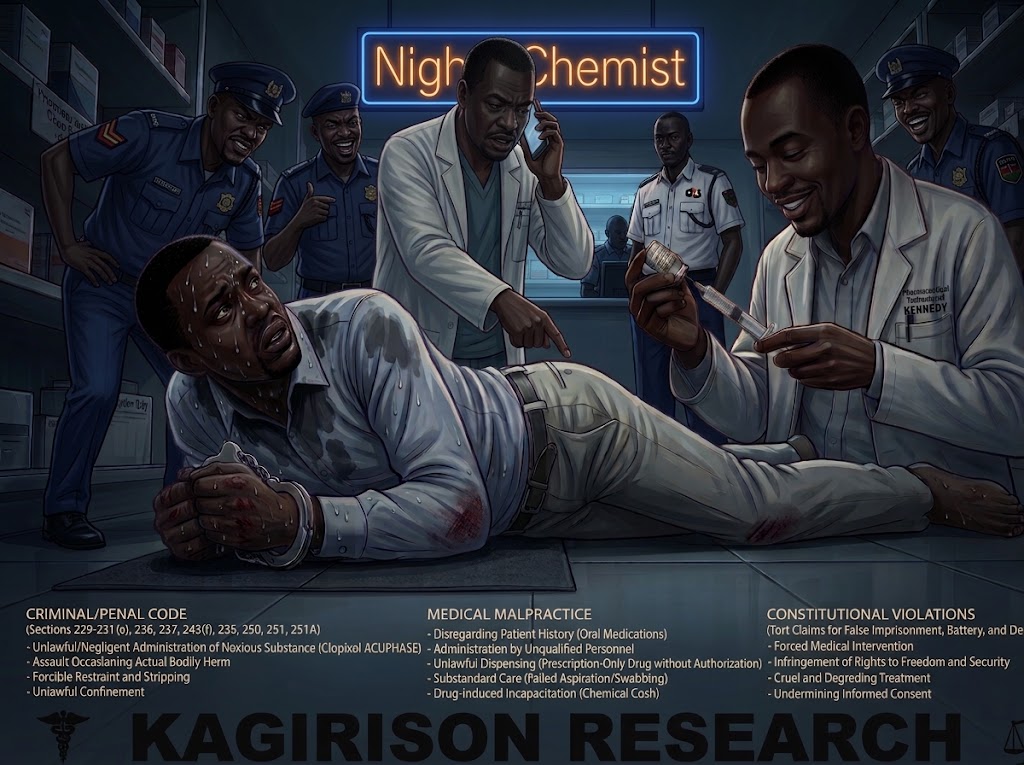
The use of Safaricom resources by Andrew Ngure, a Safaricom manager, to track, ambush, assault, and forcibly remove Peterkin Mshambala raises the possibility of vicarious liability and exposes the company to potential litigation, subject to evidence establishing the extent of Ngure’s employment-related conduct and the applicability of relevant legal principles, including the course of employment test, the common law close connection test, and the enterprise liability principle, as well as potential for claims based on negligent supervision.
Following the non-consensual forcible injection of Clopixol ACUPHASE® at Farmatica Night Chemist, Peterkin Mshambala spent the night inside his locked Honda Insight, where he was subjected to nocturnal surveillance. On the morning of 28th May 2019, as he was on the way to his professional engagement at Global Soil Week in Gigiri, he reports that he was assaulted by Andrew Ngure, a Safaricom manager, who subsequently organized and mobilized a group assault against him. The assault culminated in Peterkin being mobbed by raucous boda boda riders, who subdued him and forcibly loaded him into a waiting vehicle. At that point, Peterkin loudly objected to his forcible removal, stating that Ngure had no statutory authority to arrange his detention and that “his family needed to be contacted and informed immediately of what was taking place”. In relation to Safaricom, these allegations raise concerns about the possible misuse of corporate assets and potential violations of the company’s code of conduct in connection with Peterkin’s forcible removal and subsequent chemical restraint.

Forcible Sedation
Immediately after Peterkin Mwakio Mshambala explicitly demanded that his nuclear family be contacted, thereby putting the ambulance personnel on notice that, according to him, his family had not been informed, and directly challenging Ngure’s asserted authority to initiate or procure his involuntary psychiatric admission, Ngure approached the ambulance and stood besides the open door of the patient compartment.
Andrew Ngure then asked Peterkin to provide the contact details of his immediate family. Peterkin reports that he promptly recited from memory eight telephone numbers – two each for his mother, sister, and two brothers. This reported ability to retrieve multiple family contact numbers raises a question about how his cognitive functioning was assessed against the portrayal of his condition as an “acute psychiatric decompensation”. Ngure subsequently claimed that none of the numbers could be reached, although Peterkin maintains that Ngure merely pretended to make the calls. Ngure then contacted Alex Mzungu Bombo, who was not a member of Peterkin’s family. Bombo’s involvement raises the further question of whether he was intended to serve as an alternative source of medical history and material information in support of the proposed psychiatric admission, in the absence of a report from Peterkin’s immediate family (members).
Despite being present and having heard that Ngure had been unable to reach any of Peterkin’s immediate family members, the male nurse and other ambulance personnel had also been put on notice by Peterkin’s express objections concerning Ngure’s apparent lack of statutory authority to initiate or procure his psychiatric restraint or involuntary admission. Nevertheless, the male nurse reportedly proceeded to administer an intravenous substance to Peterkin. By this point, Peterkin was inside the patient compartment.
According to his (Peterkin) account, a boda boda rider, probably summoned and paid by Ngure, was brought into the compartment to assist the nurse in physically restraining him during transit. After the ambulance had begun moving, Peterkin reports that the male nurse received a telephone call instructing him to administer a second injection. As he briefly regained alertness after a period of diminished consciousness, Peterkin confronted the nurse and the boda boda rider.
Although his hands were restrained, Peterkin warned that he could still resist by head-butting the nurse and knocking his teeth out. He further warned the nurse that, if he approached with another syringe, “he should remember what a toothless man looks like” – a veiled threat that may have intimidated the nurse.
Peterkin reports that the nurse abandoned the attempted second injection, after which he lapsed into heavy sedation as the ambulance drove towards the then Mathare Mental Hospital (now Mathari National Teaching and Referral Hospital). Meanwhile, Ngure drove his Safaricom vehicle towards the hospital, either following the ambulance or arriving before it.
Next-of-Kin Stand-Off
When Peterkin regained consciousness, he was already at Mathari Mental Hospital. He reports that Ngure was making a determined effort to persuade the hospital’s admissions staff to accept him as an acute psychiatric case. At this point, it is evident that the ambulance had reached the hospital, where Peterkin was brought before the healthcare staff for assessment and possible admission. As Ngure sought to secure an involuntary emergency psychiatric admission, Peterkin reportedly protested vehemently, invoking the laws governing mental health in Kenya and challenging Ngure’s authority to initiate or procure his involuntary admission.
Peterkin maintained that Ngure was not his next of kin and lacked the requisite authority to act on behalf of his immediate family. The hospital staff subsequently sought to verify his next of kin and asked Peterkin to provide a telephone number for an immediate family member. He provided his mother’s number. Although the hospital staff reportedly asked Ngure to contact her, he did not do so. The hospital staff therefore contacted Peterkin’s mother directly, apparently seeking to establish the position of his immediate family before proceeding with the proposed involuntary admission.
A healthcare provider then telephoned Peterkin’s mother who was in Shimba Hills at that time. The following is Peterkin’s recollection of the conversation as his mother subsequently reported it to him.
“Do you know Peterkin Mshambala? Who is he to you?” the healthcare provider reportedly asked.
“Yes, he is my son,” his mother replied.
The healthcare provider then explained, “Some people have brought him in asking us to admit him, yet we can only act in concert with next of kin, which you happen to be”.
The healthcare provider’s reported statement raises critical questions about the identity and authority of the individuals who brought Peterkin to Mathari Mental Hospital and requested his admission. By stating that the hospital could only act “in concert with next of kin”, the provider appeared to distinguish those who had brought Peterkin to the hospital from his mother, whom the provider identified as his next of kin.
Peterkin’s mother asked to speak directly with her son, and the healthcare provider reportedly handed the telephone to him. After speaking with Peterkin and hearing his account, his mother stated that he did not require involuntary admission. She added that, should he ever require psychiatric care, she would arrange it at a private facility of her own choosing. She then expressly instructed the hospital staff not to admit him.
Attempted Subversion
According to Peterkin, while his mother was speaking with the healthcare provider, Ngure and Alex Bombo, who had by then arrived at the hospital, telephoned his brother and sister in the coastal region. According to Peterkin, they instructed his siblings not to inform their mother, asserting that “they were in control of the situation, it being not serious at all”. His siblings disregarded that instruction and alerted their mother, prompting her to arrange urgent overnight transport from Shimba Hills to Nairobi.
In what can be described as an active attempt to isolate Peterkin from statutory next-of-kin protection while trying to force a psychiatric hold, Alex reportedly telephoned Peterkin’s brother and instructed him not to inform their mother that Peterkin was at Mathari Mental Hospital, claiming that they “didn’t want her to be worried”. Shortly afterwards, when Peterkin’s mother spoke to Ngure by telephone, Ngure similarly sought to dissuade her from travelling to Nairobi, asserting that “they were managing the situation well”. When Peterkin’s mother remained resolute and informed Alex that she intended to travel to Nairobi, Alex reportedly expressed disappointment and attempted to redirect her, instructing her not to proceed to Peterkin’s home in Ngong upon arrival in Nairobi, but to go instead to another destination.
In what can be described as an active attempt to isolate Peterkin from statutory next-of-kin protection while trying to force a psychiatric hold, Alex reportedly telephoned Peterkin’s brother and instructed him not to inform their mother that Peterkin was at Mathari Mental Hospital…
External Procurement of Clopixol ACUPHASE®
Peterkin reports that when he was in the hospital, a female healthcare provider declined to consult him directly because he was verbally confrontational towards Ngure. Instead, she reportedly obtained information from Alex Bombo and formed clinical impressions based on the information Alex provided.
Peterkin further reports that a male nurse whom he remembers as being named Kirimi spoke with Alex Bombo and prepared to administer a further injection of Clopixol ACUPHASE®. According to Peterkin, the drug was unavailable at Mathari Mental Hospital, prompting Andrew Ngure to leave the hospital and drive his Safaricom vehicle to go procure it from an external source before returning with it. The circumstances raise questions about why Clopixol ACUPHASE® was specifically sought, and what clinical assessment, if any, supported its proposed administration. Peterkin’s account does not, by itself, establish the precise procurement arrangements.
The specific selection of Clopixol ACUPHASE® warrants closer examination. According to the published account of the forcible drugging at Farmatica Night Chemist in Ngong, Peterkin had been forcibly injected with Clopixol. Considered alongside the subsequent events at Mathari Mental Hospital, this raises questions about the extent of Ngure’s and Bombo’s knowledge of this forcible drugging, and about Bombo’s knowledge of the drug and its intended use when he reportedly discussed it with the nurse before the proposed injection. Peterkin’s account identifies Bombo as someone who communicated with Ngure and spoke with the nurse before the proposed administration. However, the nature and extent of any information exchanged between these men about the drug remain matters requiring corroboration.
Peterkin’s medical history raises a further question. Did Ngure or Bombo know that Peterkin had previously experienced adverse reactions after receiving Clopixol? If yes, did they disclose that history to the hospital staff before a further injection was proposed? If they were unaware of those previous adverse reactions, on what basis did they purport to provide information about Peterkin’s medical history? Did either man establish Peterkin’s relevant medical history before the further injection was proposed? Did they recognize that the information available to them might be incomplete and insufficient to inform such a decision? Without an accurate account of Peterkin’s previous treatment and adverse reactions, hospital staff may not have had information relevant to assessing the risks of re-exposure to Clopixol, potentially exposing him to a recurrence of adverse effects, including serious neurological reactions. The central question is whether the proposed injection was supported by an adequate clinical assessment and reliable medical information, rather than assumptions based on incomplete knowledge of Peterkin’s treatment. The available account does not establish who knew of those earlier reactions, whether the nurse was informed, or what clinical rationale, if any, was provided to justify the proposed treatment.
Other reported circumstances provide context for the events at Mathari. Peterkin states that he was resisting the proposed involuntary admission, that hospital staff contacted his mother in Mombasa, and that she expressly opposed his admission after speaking with him. He further reports that his mother was preparing to travel to Nairobi. Against that background, Ngure’s reported departure to obtain the unavailable drug and subsequent return with it raises questions about the urgency and purpose of the proposed injection, particularly whether the decision was supported by an independent clinical assessment and an appropriately documented treatment plan. Any suggestion that Ngure acted to prevent Peterkin from leaving the hospital before his mother arrived would, however, require evidence beyond the sequence of events alone.
According to Peterkin, he cannot independently confirm whether he received an injection of the Clopixol ACUPHASE® that Ngure had reportedly procured, although he believes that he was injected. He further recalls experiencing foggy and fragmented recollection of events for approximately seven days following the drugs reportedly administered in the ambulance and at Mathari Mental Hospital. Peterkin attributes this impairment in his recollection to the effects of the substances administered during this period. However, the available account does not independently establish which substances were administered, whether the procured Clopixol was among them, or the extent to which any particular substance contributed to his reported memory difficulties.
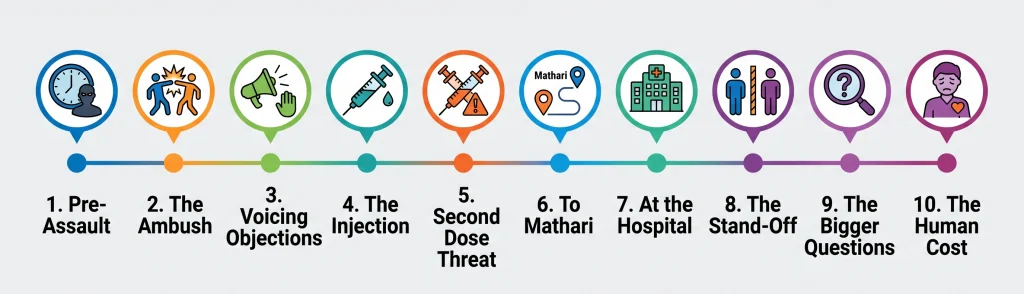
Nonetheless, the circumstances raise important questions about the proposed use of Clopixol, the information available to those involved, the clinical basis for the intended treatment, and the decision-making process surrounding Peterkin’s proposed admission.
Admission Declined
According to Peterkin’s account, following express objections from both him and his mother, Mathari Hospital staff declined to proceed with the proposed admission and verbally instructed Andrew Ngure to drive him home. This reported decision remains subject to verification against official hospital records, should such records be available.
Peterkin reports that, after the proposed admission was declined, Ngure arranged for him and Alex Bombo to board the Safaricom vehicle and drove away from the hospital with them. Peterkin agreed to travel in Ngure’s vehicle rather than attempt to navigate public transport because he remained severely groggy and affected by the drugs he had received, making the alternative journey from Nairobi to Ngong potentially difficult and unsafe. During the drive, Ngure reportedly adopted a cordial demeanour and even offered Peterkin lunch.
Given Peterkin’s impaired condition, accompanying him appeared necessary to facilitate his safe return. His immediate family was also aware that he was in the company of Ngure and Bombo, leaving both men potentially accountable to the family for his welfare during that period. However, contrary to the reported instruction to take Peterkin home, the journey did not proceed directly to his residence. The next installment will examine the subsequent circumstances in which Peterkin was taken to another destination.
The alleged use of a Safaricom-allocated vehicle by Andrew Ngure, a Safaricom manager, in connection with Peterkin Mshambala’s reported forcible removal, involuntary psychiatric admission attempt, and subsequent transportation raises potential vicarious liability and corporate litigation exposure for Safaricom, subject to evidence establishing the extent of Ngure’s employment-related conduct and the applicable legal requirements.