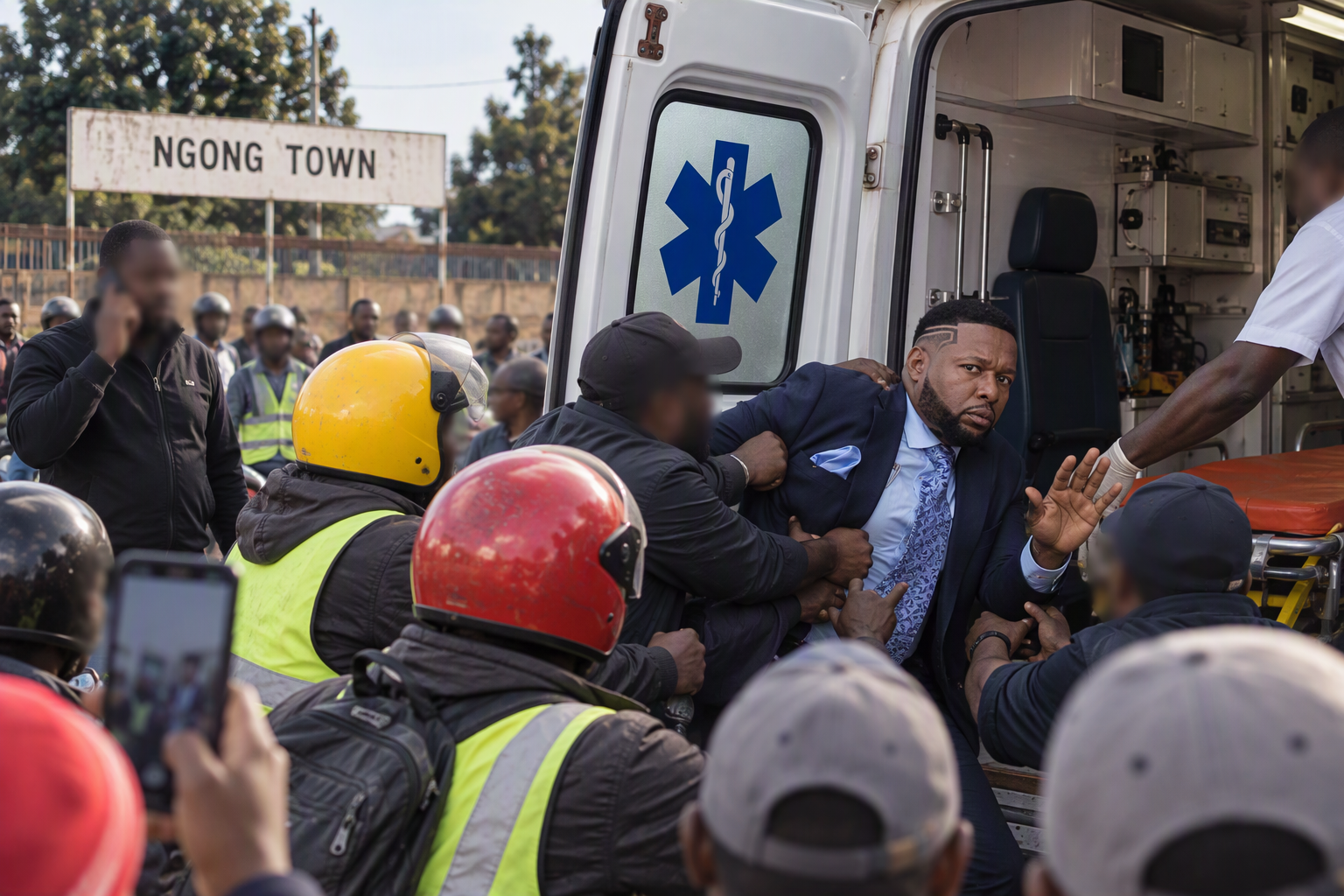
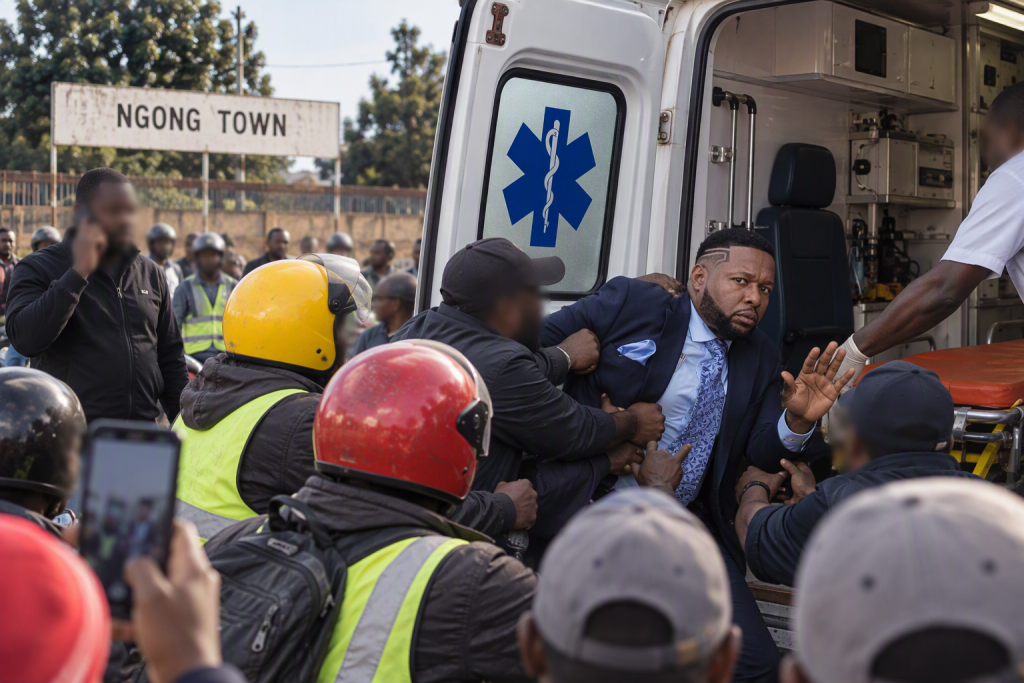
Peterkin shouted to the assembled onlookers and bystanders that Andrew Ngure – the Safaricom manager who had used company resources in the effort to intercept and forcibly remove him – was not a member of his nuclear family, possessed no known statutory or familial authority to arrange his detention, and that his family needed to be contacted and informed immediately of what was taking place. For Peterkin, the events of that day would have lasting psychological impact: he was mobbed by boda boda (motorbike) riders, subdued, and forcibly loaded into a waiting vehicle.
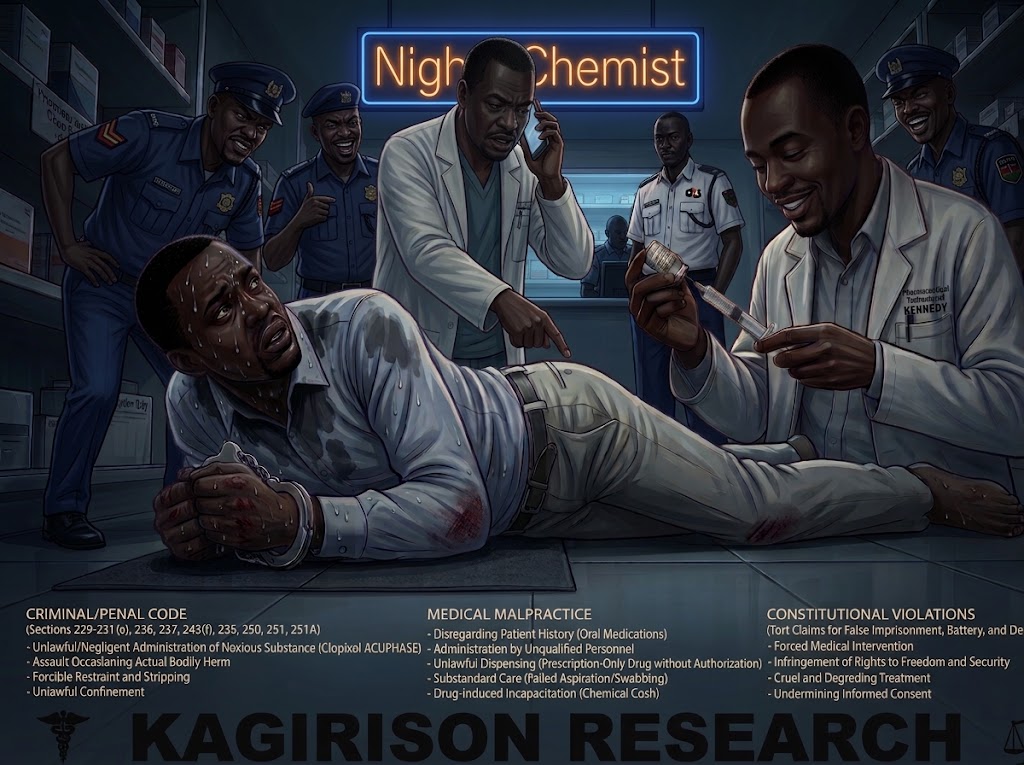
As dawn broke over Ngong town on 28th May 2019, Peterkin Mshambala emerged from his vehicle, which was parked outside Farmatica Night Chemist, where he had spent the night following his forced restraint and non-consensual injection with the neuroleptic sedative, Clopixol ACUPHASE®. Before walking home, Mshambala took the calculated precaution of disconnecting his vehicle’s ignition wires to prevent it from being driven away to be vandalized in his absence. This precaution arose from what can best be described as nocturnal reconnaissance, and reflected a reasonable concern that hostile or predatory actors might attempt to interfere with his vehicle. As the events described below indicate, that concern takes on greater significance in light of what appears to have been prior coordination surrounding the events that unfolded that morning, including the boda boda swarm that ultimately left him with chronic psychological trauma.
Containment Check
In the early hours of Tuesday, 28th May 2019, Peterkin Mshambala remained locked inside his Honda Insight, seeking to protect himself from further assault and forcible drugging. Sam, a neighbor from his residential compound in Ngong, walked over to the vehicle to ascertain whether Peterkin had indeed remained inside the car. This inspection appears to have served as a “containment check”: an effort to confirm that Peterkin remained inside his vehicle following the assault at the chemist, while also assessing his physical and psychological condition, including whether he had become disoriented, delirious, or otherwise unable to function normally as a result of the preceding events (described in this previous post).
Taken together with what had already occurred, this episode suggests that someone, or a group of people, had actively networked with, briefed, and recruited local residents in Ngong during the night. Viewed in light of the subsequent events, these activities appear unlikely to have been incidental. Rather, they are consistent with the inference that a trap was being set for Peterkin.
Trap, Ambush, and Assault
Peterkin reports that, after arriving at his house at dawn, he showered, dressed in a professional suit, and took his backpack with him, determined to fulfill Day 2 of his contract at Global Soil Week, which was taking place at the World Agroforestry Centre Campus in Gigiri, approximately 29 kilometers away by road.
Upon stepping out of his compound gate, Mshambala noticed a Safaricom double-cabin pickup truck parked outside. Almost immediately, Mshambala saw Andrew Ngure – a Safaricom manager – standing near this vehicle, and he appeared to have been waiting for him (Peterkin) to emerge from his residence. Without greeting Peterkin, inquiring about his well-being, or attempting any peaceful discussion, Ngure physically assaulted him without provocation, attempting to wrestle him to the ground and restrain him by force.
Peterkin managed to overpower Ngure and made a run towards the gate where he was confronted by the same neighbor (Sam) who had surveilled him during the night outside Farmatica Chemist. Both men assaulted Peterkin, attempting to wrestle him to the ground and forcibly restrain him.
The neighbor’s transformation from nocturnal spotter to a physical assailant that morning revealed that the earlier surveillance and the subsequent assault were part of an unfolding plot. In addition, the neighbor’s surveillance indicated that a coordinated trap had already been set hours before the morning ambush took place. The nocturnal reconnaissance had been intended to establish whether Peterkin was still reachable, as well as determine whether the drugging had caused him to become sedated or delirious.
Someone had informed the Safaricom manager – Andrew Ngure – that Peterkin was not sedated and had arrived at his residence. This seems to have presented an opportunity for another attempt to forcibly restrain and incapacitate him (Peterkin), this time at his residential apartments, without creating a public spectacle or involving the police again.
The morning assault by Ngure and Sam, which was intended to restrain and incapacitate Peterkin, ultimately came a cropper when Peterkin successfully fought off both assailants. Ngure later admitted that, despite their numerical advantage, the two men had been overpowered by Peterkin.
Someone had informed the Safaricom manager – Andrew Ngure – that Peterkin was not sedated and had arrived at his residence. This seems to have presented an opportunity for another attempt to forcibly restrain and incapacitate Peterkin.
Safaricom Resources and Traumatizing Assault
At this point, a question needs to be asked: why was the Safaricom company vehicle there? To answer this question, it is necessary to determine whether the absence of this vehicle would have hampered the execution of the plot against Peterkin. A further question is whether the plot against Peterkin involved the premeditated use of Safaricom resources, including vehicle, fuel, airtime, and other resources, as well as their use for contingency planning in the event that the plot to manufacture a cause for involuntary emergency admission failed.
The circumstances suggest that, upon receiving information that Peterkin was not incapacitated and had reached his house, Ngure decided to intercept him at dawn and therefore used his company vehicle before reporting to work. The use of the Safaricom pickup truck is consistent with the possibility that corporate assets were deliberately used to facilitate the planned interception, which led to this unprovoked physical assault and the subsequent attempt to force an involuntary hospital transfer before Peterkin could make his public appearance. In this context, Peterkin’s “public appearance” refers to his attendance at the Global Soil Week engagement in Gigiri, where his participation and successful performance of his assigned tasks would have provided an immediate challenge to any narrative of “acute mental instability” by publicly demonstrating his functional capacity.
The circumstances surrounding Ngure’s decision to drive his Safaricom double-cabin vehicle to Peterkin’s residence that morning therefore raise the possibility that he intended to intercept Peterkin during his morning commute, a circumstance that assumes greater significance in light of the subsequent events, which corroborate the inference that he intended to intercept and forcibly restrain Peterkin.
The circumstances suggest that the Safaricom-allocated double-cabin pickup truck provided Ngure with command-and-control mobility and logistical leverage for his actions. The use of the Safaricom (company) vehicle is consistent with the possibility that corporate assets were deliberately co-opted to facilitate the interception, physical restraint, and attempted involuntary hospital transfer of Peterkin before he could make his public appearance at the Global Soil Week engagement in Gigiri.
After Peterkin had successfully repelled the physical assault, he exited his residence and walked towards the main road to take public transport for the first leg of his commute to Gigiri. At this point, Ngure escalated his efforts to intercept Peterkin by using his mobile phone and airtime (which could be company-provided airtime) to mobilize and coordinate local boda boda riders (motorbike taxi riders) and an ambulance. Peterkin could hear Andrew coordinating the mobilization of the boda boda riders and the ambulance before he (Peterkin) was subsequently swarmed and mobbed by these riders.
Peterkin reports that Andrew Ngure drove his Safaricom-allocated vehicle to Ngong Stadium, where an ambulance was already parked and waiting to transport a patient. According to Peterkin, the ambulance was not merely present at the stadium; it was positioned there in readiness to receive and transport a patient, who, as events subsequently revealed, was Peterkin himself. Peterkin later came to learn that the intended destination of the ambulance was the then Mathare Mental Hospital, now Mathari National Teaching and Referral Hospital.
The circumstances suggest that the Safaricom-allocated double-cabin pickup truck provided Ngure with command-and-control mobility and logistical leverage for his actions. The use of the Safaricom (company) vehicle is consistent with the possibility that corporate assets were deliberately co-opted to facilitate the interception, physical restraint, and attempted involuntary hospital transfer of Peterkin before he could make his public appearance at the Global Soil Week engagement in Gigiri.
Peterkin reports that matters escalated dramatically when he was suddenly swarmed by a mob of boda boda riders. Outnumbered and overwhelmed by the sheer number of riders converging on him, Peterkin was subdued and the raucous mob forcibly took him to the waiting ambulance. He was forced into the ambulance’s patient compartment – the module box designed to accommodate and transport a patient.
According to Peterkin, this experience was profoundly traumatizing. Being suddenly surrounded, physically overpowered, and subdued by a rowdy mob, and forcibly taken to an ambulance awaiting his arrival represented a terrifying loss of personal autonomy and control. Based on Peterkin’s description of the vehicle and its configuration, I can categorize this ambulance as a Type-B patient transport truck ambulance.
The forensic trail suggests that the plot against Peterkin Mshambala was set in motion hours before dawn. During the night of May 27, while Mshambala remained locked inside his Honda Insight outside Farmatica Night Chemist to survive the effects of the forced neuroleptic injection, local coordination appears to have been underway in Ngong. In a telling indication of possible premeditation, one of Mshambala’s immediate residential neighbours went to establish whether Mshambala had indeed locked himself inside his vehicle. This nocturnal reconnaissance raises two significant possibilities: first, that local individuals were being enlisted as spotters in advance of the following morning’s events; and second, that the assault at Mshambala’s residence the next morning was not an isolated or spontaneous encounter, but the execution of a plot formulated overnight.
The circumstances surrounding the ambulance’s presence at Ngong Stadium become particularly significant when considered alongside the events that had unfolded at Peterkin’s residence and the subsequent efforts to intercept him. The apparent convergence between the assault, the mobilization of boda boda riders, and the presence of an ambulance already waiting to receive a patient is consistent with the possibility that the ambulance had been positioned in advance to receive the person whom Ngure and his accomplices were attempting to intercept, restrain, and deliver for involuntary hospital admission. Likewise, Ngure’s apparent knowledge of the ambulance’s location is particularly significant.
The fact that an ambulance was already waiting at a predetermined location, at the same time that Ngure and Sam were attempting to restrain Peterkin at his residence and subsequently intercept him on his way to catch public transport, is consistent with prior coordination of the intended transfer. This sequence raises the possibility that the morning assault was not an isolated physical confrontation, but part of a coordinated effort in which Peterkin was to be intercepted and forcibly taken to the waiting ambulance. Basically, the convergence of these events supports the inference that the location of the ambulance had been determined in advance as the point at which Peterkin was to be handed over for transport to Mathare Mental Hospital.
As he was being forcibly loaded into the ambulance’s patient compartment, Peterkin loudly called out to the assembled onlookers and bystanders, stating that Andrew Ngure was not a member of his nuclear family, that Ngure had no statutory or familial authority to order his detention, and that his nuclear family needed to be contacted and informed immediately of what was taking place.
This constituted a public declaration of non-consent and provides evidence that Peterkin actively resisted the transfer and expressly disavowed any suggestion that he was consenting to, or voluntarily complying with, it. His statements were made in the presence of third-party witnesses before the ambulance departed.
Peterkin’s statements also amounted to a direct challenge to Ngure’s asserted authority to initiate or procure his involuntary psychiatric admission. By publicly disputing Ngure’s authority under the Kenyan Mental Health Act (Cap. 248), Peterkin placed those present on notice that he did not regard Ngure as having the requisite legal authority to arrange his detention or psychiatric admission. The precise scope of any such authority would, however, depend on the applicable statutory provisions and the circumstances of the proposed admission. The next installment examines what happened when Ngure took Peterkin to Mathare Mental Hospital, including the fact that Ngure did not identify himself as a member of Peterkin’s family or as his relative. This omission is particularly relevant to the questions surrounding Ngure’s asserted authority to procure Peterkin’s involuntary admission and the extent to which the hospital was informed of the relationship, or lack of familial relationship, between the two.
Of note, Peterkin’s explicit demand that his nuclear family be contacted put the bystanders and ambulance personnel on notice that his family had not, according to him, been contacted and that he wanted them informed immediately. These statements may be relevant to establishing what those present knew about his objections, his lack of consent, and his request for family notification before the ambulance departed.
The information provided has established that the Safaricom double-cabin truck provided command-and-control mobility. Likewise, the use of the Safaricom pickup truck demonstrates both pre-work opportunity and possible deliberate use of corporate assets to execute an unprovoked physical assault and attempt to transport Peterkin to hospital against his will.
The next installment examines what happened when Ngure took Peterkin to Mathare Mental Hospital, including the fact that Ngure did not identify himself as a member of Peterkin’s family or as his relative. This omission is particularly relevant to the questions surrounding Ngure’s asserted authority to procure Peterkin’s involuntary admission and the extent to which the hospital was informed of the relationship, or lack of familial relationship, between the two.