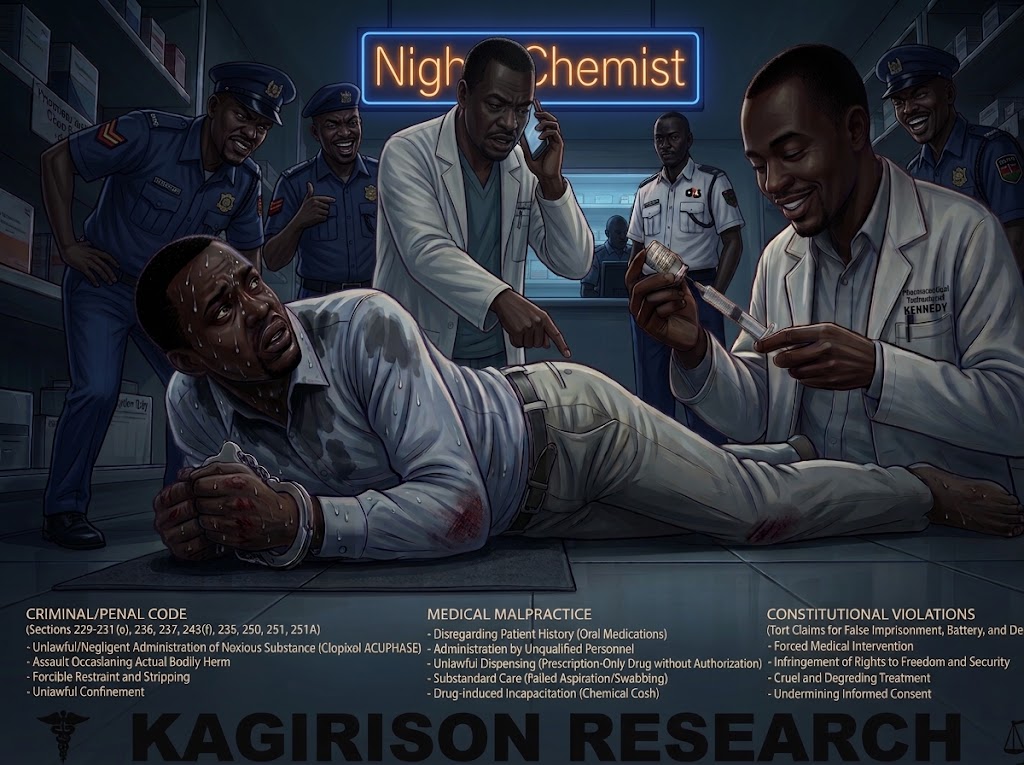
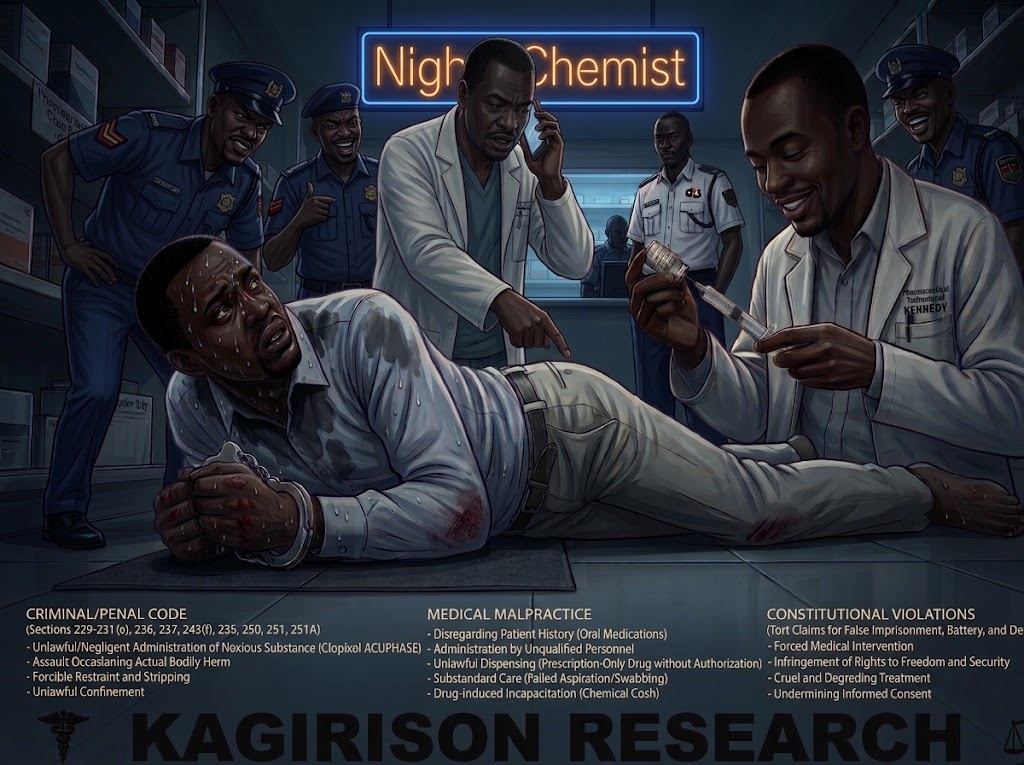
This is a multi-part serialized report. This first part focuses on a premeditated, coordinated assault carried out pursuant to a common intention.
During the day, he demonstrated cognitive lucidity and professional competence while performing his duties at the Global Soil Week summit at ICRAF, Gigiri, where he received formal acclaim; that night, he was lured and assaulted in a chemist, physically restrained and handcuffed, and forcibly injected with a neuroleptic agent with the apparent aim of inducing sedation and medication-induced incapacity, so as to render him unable to provide valid informed consent.
Global Soil Week
On 16th May 2019 at 10:43 a.m., James Gachara of Seamless Events wrote to Peterkin Mwakio Mshambala confirming that Peterkin had accepted an assignment to provide interpretation services at Global Soil Week 2019 from 27th May to 29th May 2019, with later phone communication extending the assignment to 31st May 2019 so that Peterkin could cover the entire engagement, including its plenary and breakout sessions. The communication identified the engagement as Global Soil Week 2019 and directed Peterkin to register online for logistical purposes, and provided the requisite interpreter invitation code.
Global Soil Week 2019 took place from 27th May to 31st May 2019, at the World Agroforestry Centre (ICRAF) Campus located along United Nations Avenue in Gigiri, Nairobi. It was organized and co-facilitated by, among others, Alexander Müller (Managing Director of TMG Research), Dr. Alice Kaudia (Co-Founder of Eco-Entrepreneurs Ltd), and Tony Simons (Director-General of ICRAF). This event convened high-level international stakeholders to advance sustainable land management. Key dignitaries included Lucy Njenga, representing Kenya’s Cabinet Secretary for Agriculture; Heiko Warnken and Daniel Alker from the German Federal Ministry for Economic Cooperation and Development and the German Embassy to Kenya; along with Rabeharivololona Ony Malalaniaina, Jeanne Josette Acacha Akoha, Etefa Diba Areri, Usha Rani, and Zacharie Segda who were senior government representatives from Madagascar, Benin, Ethiopia, India, and Burkina Faso respectively. At the conclusion of the day’s proceedings on 27th May 2019, during the evening Vote of Thanks led by a Senegalese delegate, Peterkin was among those who received a standing ovation in recognition of the professional and exemplary interpretation services that had made the event a success on that day.
Ruse, Assault, and Drugging
According to Peterkin, on 27th May 2019, he completed his assignments for the day at Global Soil Week 2019, and then met several friends at Alliance Française. Thereafter he took public transport to Ngong Town and proceeded home, where he took his car and drove to Ngong town to do some shopping.
At Ngong town, he says that he parked his car outside Farmatica Night Chemist, opposite Diamond Butchery. According to his subsequent accounts, he was initially invited into the chemist by two individuals known to him as Kennedy and Muhenga, who were either pharmacists or chemists, or were presenting themselves as such, and both knew that he had been taking prescribed oral medications. As he was no longer on friendly terms with them, he became suspicious of their intentions and initially declined to enter the premises. He states, however, that he was subsequently persuaded to enter the chemist by an acquaintance, a police officer named Kazungu, who was then stationed at Ngong Police Station.
Inside Farmatica Night Chemist, he found two more policemen, together with Kennedy and Muhenga, as well as a G4S security guard known to him. He reports that he was then assaulted and knocked off his feet, causing him to fall to the floor, where he was handcuffed with his hands restrained in front of his body. He states that his trousers were subsequently loosened and pulled down, exposing his buttocks. At that point, he saw Kennedy drawing a liquid substance from a vial into a syringe.
Peterkin states that he protested the assault and questioned why he was being restrained and prepared for the administration of the substance. He further protested that the conduct was unlawful and attempted to support his objections by referring to the law. According to his account, Muhenga rudely dismissed these objections and rebuffed his protestations.
According to Peterkin, some of the aforementioned individuals in the chemist told him that he had “run mad,” was considered a danger to himself and others, and therefore required urgent medical intervention; and thereafter proceeded on their own volition to administer ad hoc non-consensual medical intervention.
Peterkin reports that he was injected with the drug in the gluteal region. The physical restraint and involuntary administration of intramuscular injection occurred despite his pleas and attempts to explain that he had been working as an interpreter at an international event earlier that day and had successfully completed his professional duties. He further reports that the injection site was not swabbed prior to administration, which ordinarily exposed him to injection-site infections. He describes the injection as painful, stating that it was administered suddenly and forcefully, and reports that, the following morning, he observed blood on his trousers over the area of the injection site. He does not recall any aspiration being done by Kennedy to ensure that the needle had not pierced a blood vessel.
Peterkin reports that, when the initial injection did not produce the intended effect of sedation or incapacitation, Kennedy became agitated and informed him that he would be administered an intravenous drug. According to Peterkin, upon hearing this and observing that Kennedy appeared intent on administering a further injection, he pretended to lose consciousness and to foam at the mouth. He subsequently requested water and was given approximately three liters, necessitating the removal of his handcuffs to enable him to drink. Peterkin states that he used this opportunity to escape, ran to his car, locked himself inside, and remained there overnight.
Peterkin reports that attempts to persuade or compel him to leave his car were unsuccessful, despite persistent threats and what he describes as attempts by those present to feign reassurance. He states that the policemen remained at the scene until after midnight, when they departed in a police utility vehicle that had been parked near the chemist. According to Peterkin, Kazungu remained at the scene for longer before leaving at about 4:00 a.m. in his blue car, which had tinted windows and a tinted windscreen.
While remaining inside his car, Peterkin reports that he disconnected the ignition wires to prevent anyone other than himself from starting and driving the vehicle. He states that he eventually left the car at approximately 5:00 a.m., amid taunting from motorcycle taxi riders, popularly known as boda boda. He reports that some motorcycle taxi riders taunted him and challenged him to a speeding contest, with some riders maneuvering their motorcycles, including riding in circles, while daring him to drive his car against them. He further reports that he ignored them and proceeded home on foot, where he arrived safely.
In later correspondence, Peterkin identified the substance that was forcibly injected into him as Clopixol ACUPHASE®, a psychotropic drug and formulation of zuclopenthixol – a first-generation antipsychotic in the thioxanthene class that is not approved for use in the United States, where it has been reviewed by the United States (US) Food and Drug Administration (FDA), the federal agency under the Department of Health and Human Services that is responsible for protecting and promoting public health through the control and supervision of dispensing and use of over-the-counter pharmaceutical drugs and prescription medications.
In Kenya, Clopixol ACUPHASE® is classified as a prescription-only medicine, and falls under controlled schedule listings managed by the Pharmacy and Poisons Board (PPB), with this listing intended to prevent its unauthorized distribution or improper clinical use. Normally, pharmaceutical technologists (who ordinarily run and manage chemists in Kenya), are discouraged from administering Clopixol ACUPHASE® because of its adverse effect profile that includes high-risk, life-threatening complications, such as neuroleptic malignant syndrome, cardiac arrhythmias, and acute extrapyramidal symptoms, that require immediate hospital-level monitoring and intervention.
Manufacturing a Cause for Involuntary Emergency Admission
One of the exclusion criteria for administering Clopixol ACUPHASE® as an intramuscular injection is if the patient is taking oral medication(s), and in the circumstances that Clopixol should be administered, its oral alternative – that is oral zuclopenthixol – which reaches peak plasma concentration in 3-6 hours, is given and its dose titrated carefully to minimize the adverse effects. In comparison, intramuscular zuclopenthixol acetate (Clopixol ACUPHASE®) reaches peak plasma concentration about 24–48 hours after injection, typically around 36 hours. According to the January 2026 review by the Right Decision Service that is linked to the National Health Service, the sedative effects of Clopixol ACUPHASE® “usually begin to be seen 2 hours after injection and peak around 36 hours (corresponding to peak serum level). The effects usually last for up to 72 hours”. Because of these pharmacokinetics, this drug is not recommended for managing psychiatric emergencies.
Normally, Clopixol ACUPHASE® must not be administered as a first-line medication for rapid tranquilization, unless an advanced directive exists authorizing it, and none existed in this case. Likewise, this drug should not be administered intramuscularly in a community setting where patient safety cannot be assured and equipment for post-administration care is not available.
If administered intramuscularly, the patient needs to be lying prone, or take the posture of bent-over standing position (also called forward-flexed standing position) so that the gluteal muscles are relaxed. The muscles need to be relaxed because the administration must be a deep intramuscular injection. This allows for the drug to be absorbed relatively slowly into the body.
The pharmacological profile of Clopixol ACUPHASE® explains why it is not ordinarily used as a first-line medication for rapid tranquilization – its effects are simply not immediate. Likewise, it should not be used to hasten the antipsychotic effect of another therapy, such as oral therapy. Both Kennedy and Muhenga knew, or ought to have known, that Peterkin was taking oral prescription medications. Additionally, this drug should not be used as a chemical cosh to rapidly control, subdue, or render a person less responsive, under the guise of coercive medication. Basically, it should not be used as a pharmacological means of incapacitation to make someone incapable of exercising their autonomy.
Accordingly, if the intention was to tranquilize Peterkin using Clopixol ACUPHASE® so that he could be incapacitated and a claim subsequently made that he was experiencing an acute psychiatric decompensation requiring hospital admission, that objective expectedly failed.
Nonetheless, once administered, even when administered improperly as is the case here, the patient can suffer its adverse effects. The adverse effects of Clopixol ACUPHASE® (zuclopenthixol acetate) – including confusion, akathisia, impaired attention, and dystonia – may persist for approximately 2-3 days. During this period, the affected person may appear visibly unwell, highly agitated, confused, or as though they are experiencing a manic episode. On their own, these side effects do induce physical and mental impairment that can be presented to healthcare practitioners as “acute manic crisis” demanding urgent involuntary emergency admission.
The drug-induced physiological effects following the unconsented administration of Clopixol ACUPHASE® were manifested by Peterkin when walking home at dawn as staggering, an unsteady gait, a dazed appearance, and slurred speech. These signs were consistent with the known sedative and neurological effects of zuclopenthixol and in the circumstances, cannot be attributable to an unmedicated manic episode. In such a state, a person purporting to be acting in good faith could reasonably perceive Peterkin’s presentation as requiring urgent medical assessment and summon an ambulance to obtain emergency healthcare. This would provide a plausible explanation for a scenario in which an individual claiming to have acted in good faith called for an ambulance, after which Peterkin, appearing incapacitated following the administration of the medication, was taken to the ambulance for transport to a medical facility. If this had occured, then what would have been achieved would be the weaponization of the sedated state for manufacturing a cause for involuntary emergency admission pursuant to section 14 of the Mental Health Act, with the likely argument being that the illness is severe and judgment is impaired, and that failure to admit is likely to cause serious deterioration and/or prevent necessary treatment that can only be provided through admission.
Violations
The improper administration of Clopixol ACUPHASE® without lawful prescription or consent, with the intent to restrain, aggrieve, and/or harm Peterkin raises concern that engages sections 229, 230, 231(e), 236, 237, 243(f), and 245 of the Kenyan Penal Code which deals with, among other, unlawful and/or negligent administration of noxious (or poisonous) substances.
The physical restraint, handcuffing, and forcible intra-muscular injection executed at the chemist can best be described as assault occasioning actual bodily harm and forcible stripping, and they engage sections 250, 251, and 251A of the Penal Code.
The luring of Peterkin into the chemist led to him being assaulted, manhandled, and forcibly restrained, which raise concern of unlawful confinement and/or false imprisonment.
The pharmacists/chemists administering prescription-only, intra-muscular psychotropic drugs without a written prescription from a licensed psychiatrist can be accused of unlawful dispensing of drugs, which is a form of medical malpractice.
The unwanted and unconsented medical interventions, the restrain that limited movement, the manhandling and assault, and the cruel and degrading treatment in the chemist were violations of constitutional rights of Peterkin Mshambala.
For reliefs, Peterkin can pursue tort claims seeking general damages for false imprisonment, battery, and unlawful detention.