This post relates selected judicial precedents, which were recently set by the High Court and Court of Appeal of Kenya, to crimes and misconduct described in previous posts covering Safaricom PLC, Directorate of Criminal Investigations (DCI), Office of the Director of Public Prosecutions (ODPP), and I&M Bank. These assorted precedents and case laws show how legislation from the bench – in combination with trite law – help address the issues of abuse of office, misconduct, and criminal activities, including financial crimes and international crimes. They also set novel approaches to legally dealing with rogue actors, such as a senior policeman who shot a magistrate in court. Also considered is the court case that Safaricom indirectly brought against me, which could still result in notice to produce pursuant to Section 69 of the Evidence Act (Cap 80, Laws of Kenya).
The responsible corporate officer (RCO) doctrine allows for a high-ranking official in a corporation to be charged in court for a crime that occurred in his/her corporation even if (s)he has no knowledge of that crime or the perpetrators of that crime…(this) doctrine is also called the responsible relation doctrine.
A Case to Win?
“Can you show us any company executives or managers that have been jailed due to research published by Kagirison Research?”, is a question I repeatedly get. “As you know, Hindenburg Research published a report that led to the jailing of Trevor Milton of Nikola Corporation”, is the follow-up comment that justifies the question.
“Have you not read about the crimes committed by Safaricom PLC and DCI that I have described in my research?”, is one of the easy answers that I could give though it cannot sufficiently answer the question because I cannot formally describe the individuals who committed those crimes as criminals. I cannot legally label them as criminals because no court has yet found them guilty of the crimes mentioned, and even a petition to the National Assembly regarding the crimes committed cannot be construed as passing judgement on them. I know this because I have in my in-tray a petition to the Senate of Kenya that seeks to have a prominent Kenyan company publicly censured for violations of the constitution, which would then set the stage for fresh court proceedings to be instituted against this company. Formally, only the court can make the determination whether one is a criminal or not.
Still, I do know that crimes were committed. When I reached out to Amazon Web Services (AWS) regarding the uploading of privileged Safaricom customer data to an S3 data bucket, AWS provided guarded answers and documents totaling over 6,000 pages that allowed for confirmation that AWS resources were illicitly exploited, and we were able to narrow down on who did this illicit exploitation. Fortuitously, AWS allowed me to use the documents provided in my research, and implicitly in any court proceedings. Besides, the findings allowed me to make the following observations:
…despite Proton AG and Amazon Web Services, Incorporated (AWS) showing readiness to procedurally and legally cooperate with the investigation into this data leak (in Safaricom), the ODPP did not pursue this path, instead choosing to rely on DCI and internal Safaricom investigations. Already, these foreign companies were cooperating to mitigate the adverse effects of the data leak.
Data Leak of 43 Million Safaricom Customer Records, KES 1.432 Billion Lawsuit, and Safaricom-DCI Conspiracy to Fabricate Evidence and Commit Statutory Crimes
If called to take a stand, I will gladly testify before the court that fabricated evidence was created through illicit exploitation of AWS infrastructure and then submitted to the trial court by the DCI through its Digital Forensics Lab. I will also show how this fabricated evidence can be traced to Eric Kabugo Mugo of Safaricom PLC.
Judiciary of Kenya, Safaricom PLC, and International Crime Involving Amazon’s AWS
Fraud and Conviction
For those unfamiliar with the matter of Hindenburg Research and Nikola Corporation, here is a summary of what transpired.
Nikola Corporation was an electric vehicle manufacturer that became wealthier than Ford Motors when its worth peaked at US$ 27 billion in the year that it was accused of fraud, deception, and false statements in a report published by Nathan Anderson on September 10, 2020, on Hindenburg Research. Being implicated in fraud in Hindenburg Research’s report, Trevor Robert Milton resigned his position as executive chairman of Nikola Corporation on September 20, 2020, though he described the accusations as “false allegations”. In July 2021, Trevor Milton was indicted for criminal fraud, and was convicted in October 2022. He was later sentenced to a 4-year jail term.
This year, in February 2025, Nikola Corporation publicly acknowledged that it was going bankrupt by filing for Chapter 11 bankruptcy protection. This means that when Milton was released (after Donald Trump pardoned him on March 27, 2025), he found the company bankrupt.
How Kagirison Research Compares to Hindenburg Research
I will start by mentioning that Kagirison Research is turning a year old next month, and Hindenburg Research was 3 years old when it published its research on Nikola Motors, and was well known as a boutique investigative research company that had cultivated productive ties with journalists of major media companies. This allowed Hindenburg Research to successfully expose fraud that was damaging global capital markets.
Hindenburg Research adopted the strategy known as informational arbitrage, which was pioneered by Manuel Asensio – a contrarian who appreciates corporate iconoclasts. Manuel Pedro Asensio-Gracia is a Cuban-born American moralist who repeatedly locked horns with the Securities and Exchange Commission (SEC), even accusing its chairperson, Mary Schapiro, of ethical violations despite threats of lawsuits and actual lawsuits. The brash and witty Asensio, nicknamed “Demolition Man”, coined the term informational arbitrage to replace his earlier term, hostile adversarial – with both terms describing the niche accountability reporting that he developed. Asensio is highly opinionated, even ascribing punishment to wrongdoers. For instance, he stated that PolyMedica Corporation should be fined US$400 million after his research uncovered fraud, though the company only paid US$35 million in fines to settle the fraud charges. PolyMedica filed for bankruptcy years later.
Comparatively, Kagirison Research exists – among other reasons – to help optimize global financial markets by keeping out, or helping to kick out, criminally-minded and lawless savages from the Third World, along with their enabling partners and allies. It does this through investigative research, accountability reporting, and postparadigmatic activism. At a personal level, this work allows me to join civilized well-intentioned people to help protect global finance from being undermined and corrupted by the aforementioned undesirable elements.
“When he gets into something (e.g uncovering fraud), he is really obsessive”, remarked Leon Cooperman of Omega Advisors when describing Asensio. Asensio considers this relentless pursuit as critical to informational arbitrage as evident in his research into Diana Corporation, whose stock value plummeted after he published his 16-page report about the company. To Kagirison Research, Asensio remains an inspiration. As an advocate of the works of professor Jonathan Haidt and social psychologist, Ziva Kunda, Asensio prioritizes decision making processes. He always asks: was the decision instinctive or deliberate? This can apply as follows to Kagirison Research in relation to the lawsuit filed against by I&M Bank. Asensio’s question regarding this matter would likely be framed as follows: “Was the lawsuit a product of instinctive decision or deliberative decision, or a combination of both?”. Having an answer to this question allows for prudent handling of the lawsuit. For example, civil lawsuits based on instinctive decisions are marked by perjury and suborned perjury by lawyers.
My goal is to contribute to the epistemic evolution of paradigms that ground existing legal and financial systems
A Case to Win?
Now, to significantly answer the earlier question of whether there has been legal accountability consequent to research published on this website; I would like to focus on the Kenyan legal system, and what better way to do so than by referencing it to the following questions.
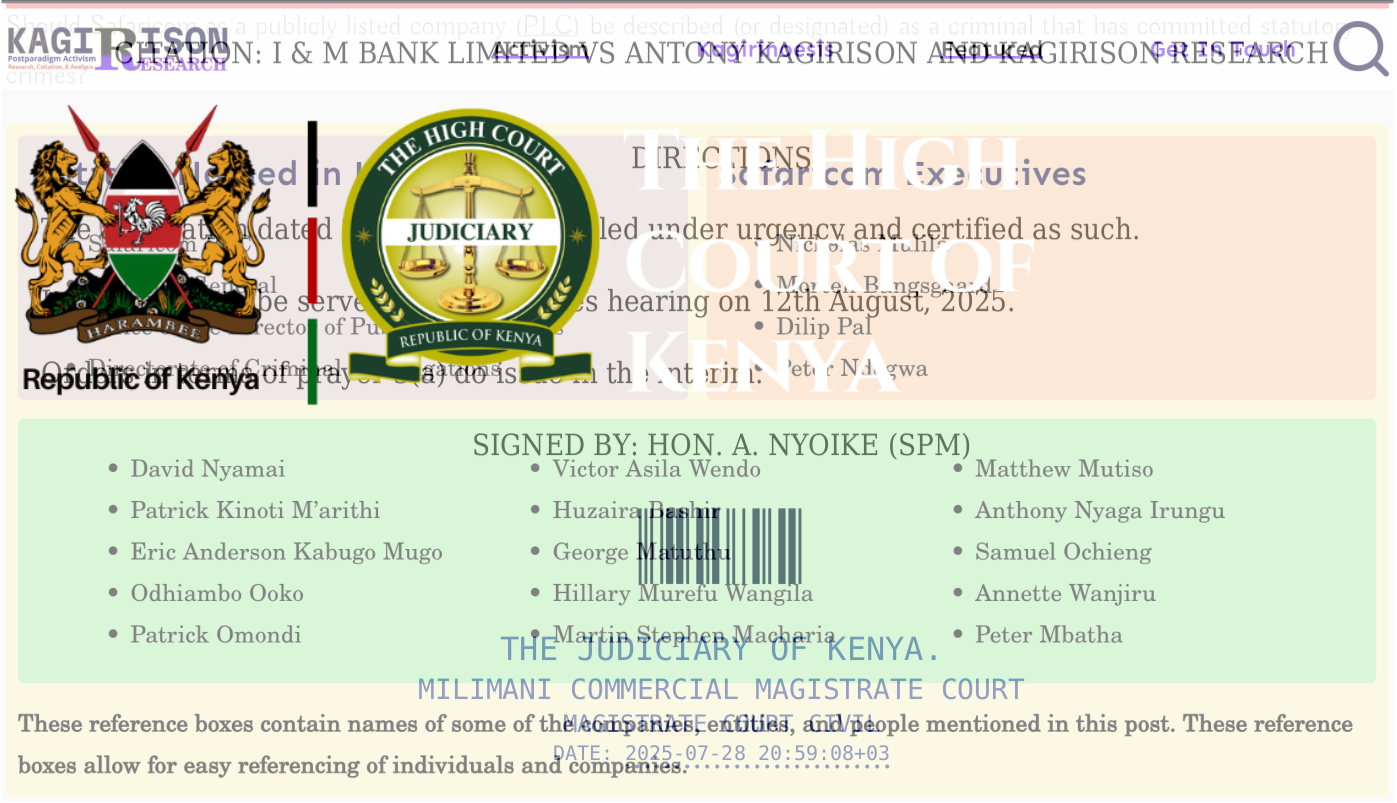
Following the conversion of about 5000 words of our research – on evidence fabrication by Safaricom and the Directorate of Criminal Investigations – from restricted access to free access on July 20, 2025; I&M Bank through their lawyers, Wamae & Allen LLP, made an application (for [exparte] orders) on July 21, 2025, and moved to court seeking gag orders and take-down orders on our research focused on CBEX operations in Kenya.
Interim Court Orders Obtained ExParte
Statutory Crimes
“So, you want to have some of the dumbest people from the Third World of Sub-Saharan Africa be arraigned in an American court, before some of the smartest jurists in the First World, on charges that they illicitly exploited one of the most secure (if not the most secure) cloud infrastructure provider in the world? Isn’t this a case of dirty prosecutors and dirty cops working for a leading Kenyan company? If so, don’t these crimes fall under state-corporate crimes?”. These are the questions I have received following the research that revealed that statutory crimes, including international crimes, were committed jointly by DCI and Safaricom PLC.
The research raised some pertinent issues. If the DCI and the ODPP could confidently submit fabricated evidence in the trial court, it means that they have done it before, and such actions gave them the confidence to do it again in their quest to subvert justice, violate the constitution, and engage in abuse of office. Also, this implies that other cases handled by the implicated DCI policemen could have been tainted by fabricated evidence. Regarding this, it is justifiable to apply the proposition of falsus in uno, falsus in omnibus in matters that involve fraud upon the court, otherwise described as court fraud. This is highlighted by recent accusations against the DCI.
Court Fraud
It is mentioned in the research that the Digital Forensics Lab (DFL) and Serious Crimes Unit (SCU) of DCI were involved in fabrication of evidence. On September 10, 2025, DCI was publicly accused of installing a spyware in a smartphone it had confiscated and taken into custody, with the accusation being publicized by Citizen Lab and the Committee to Protect Journalists.
Citizen Lab, which is based at the University of Toronto’s Munk School of Global Affairs, prepared a forensic report on this issue; and this report has been submitted to the court. So far, the court has summoned 2 DCI policemen to enter an appearance to answer an application concerning illicit exploitation of a computing device under police custody – which also constitutes evidence tampering.
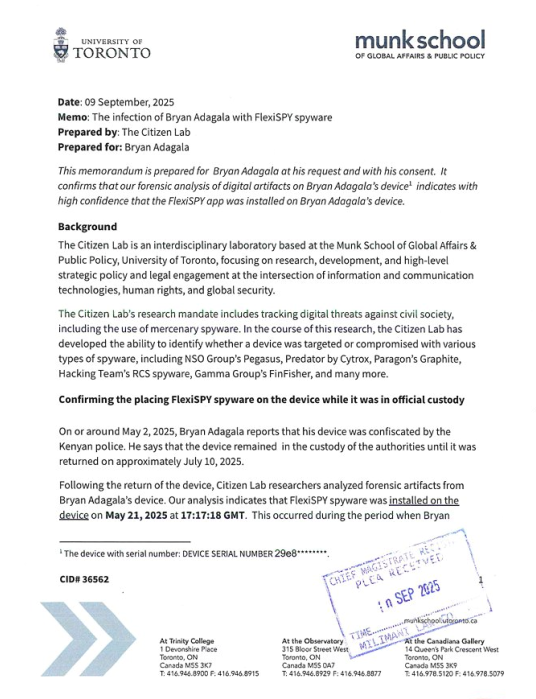
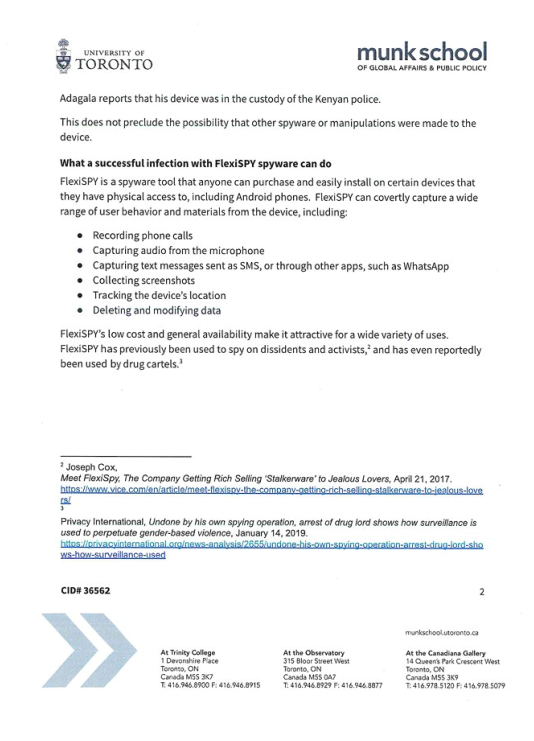
I did reach out to Citizen Lab to get access to the report. My request for the report notwithstanding, the aforementioned actions by DCI constitute police misconduct. Such misconduct has been addressed by two recent judgements. The first judgement was issued by the High Court on September 10, 2025, and the other judgement was issued by the Court of Appeal on September 12, 2025, and their ratios decidendi provides novel approaches on how to legally deal with rogue actors in the police service as is explained later. What can be noted now is that the accused policemen and the police service will be required to pay punitive damages if found guilty.
Notably, the judgement of the Court of Appeal allows the aggrieved persons to institute a case right now in the High Court against the DCI, the National Police Service (NPS), and the implicated policemen for evidence tampering and illicitly installing a spyware to a digital device under police custody. Basically, the judicial precedent of the Court of Appeal increases the litigation exposure of rogue police and their agents.
If Amazon decides to take a stand, Amazon’s AWS will experience the sub-Saharan criminal justice system that has so far allowed investigative agencies – in this case, the Directorate of Criminal Investigations (DCI) of Kenya – to illegally use AWS infrastructure to commit statutory crimes…
Judiciary of Kenya, Safaricom PLC, and International Crime Involving Amazon’s AWS
Peculiar Case
When considering the issue of court fraud, two questions come to mind regarding the extralegal relationship between Safaricom PLC and DCI. Both questions relate to institution of court cases and their integrity. Earlier, I asked if there could be other cases involving the implicated DCI policemen that could be tainted by fabricated evidence – which can necessitate vacation of court judgements or de novo retrials if appeals are lodged and are successful. Now, what about cases that Safaricom PLC has brought against individuals through the ODPP? Can any of these cases have been tainted by fabricated evidence?
Let me now mention a case that was brought against me in March 2025 by the ODPP on behalf of Safaricom PLC. To be candid, Safaricom PLC did not directly reach out to ODPP and DCI to make a case against me regarding the post titled Preliminary Notes on Upcoming Report on Safaricom Group, which was published on January 3, 2025. It hired an intermediary to ensure that the case was filed. This case is premised on allegations of publication of false information. In that post, it was stated that Safaricom PLC made staggering equity losses of about KES 1 Trillion, though some of these losses can be attributed to systemic inefficiencies of the Nairobi Securities Exchange.
I am amenable to have Safaricom PLC formally subpoenaed in court for it to explain what is contained in that post/article that fits the description of false information. I am interested in according Safaricom PLC an opportunity to get a fair hearing so that it can set out its truth, dispel allegations, counter false narratives, and uphold its integrity. This will help the company increase its brand equity, or at least, preserve it unsoiled by false allegations.
As I have noted, Safaricom PLC did not directly reach out to ODPP and DCI, it used a person who presented himself as a crisis management specialist to make this peculiar case. What happened can be surmised as follows…