Safaricom PLC has committed statutory crimes, and it now wants the judiciary of Kenya to help cover these crimes.
The principal losers in this fraud are the shareholders and customers of Safaricom.
Ndegwa, Rigathi, and Fraud in Safaricom Group
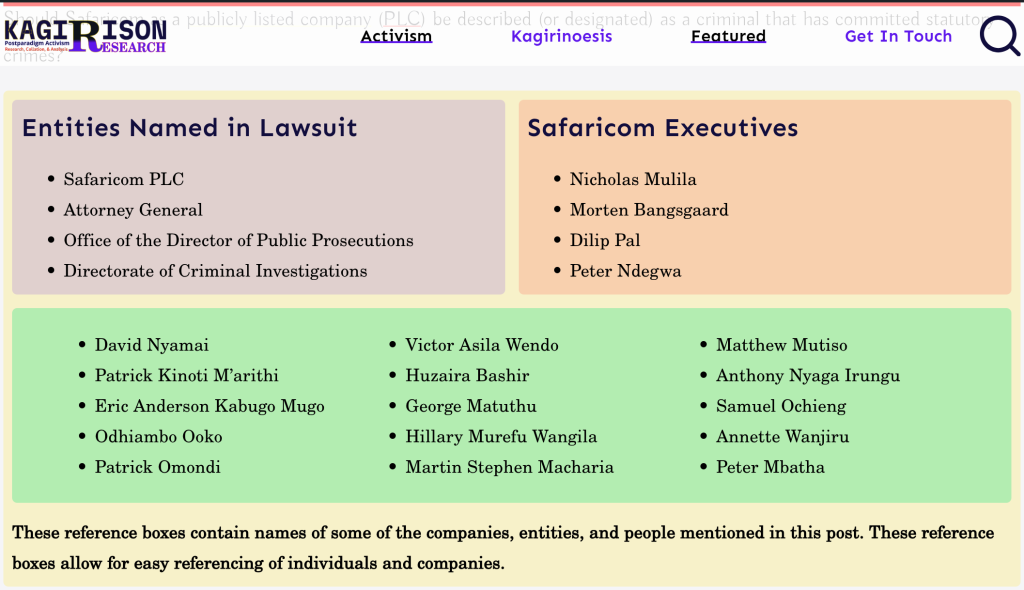
This post is a follow-up of the research titled Data Leak of 43 Million Safaricom Customer Records, KES 1.432 Billion Lawsuit, and Safaricom-DCI Conspiracy to Fabricate Evidence and Commit Statutory Crimes. To understand this post, it is mandatory that one reads that research. The crimes described in that research are the subject of three (3) cases that are currently in Kenyan law courts.
If called to take a stand, I will gladly testify before the court that fabricated evidence was created through illicit exploitation of AWS infrastructure and then submitted to the trial court by the DCI through its Digital Forensics Lab. I will also show how this fabricated evidence can be traced to Eric Kabugo Mugo of Safaricom PLC.
On May 14, 2024, the Director of Public Prosecutions (DPP) of Kenya filed a criminal appeal in Milimani High Court to contest the acquittal of Saikumar Allaka on April 30, 2024, by the Milimani Magistrate Court in a criminal case where he was accused of leaking Safaricom data. The aforementioned research confirms that the criminal case was built on fabricated evidence submitted to court by Peter Mbatha who described himself as a digital forensic examiner based in the digital forensic lab (DFL, alias Cybercrime & Digital Forensics Lab) at the headquarters of the Directorate of Criminal Investigations (DCI). Basically, Mbatha took a false stand in the trial court.
On June 25, 2024, a claim was filed in the Nairobi Employment and Labour Relations Court seeking for a judgment to be entered against Safaricom PLC for unlawful termination of an employment contract, as well as for Safaricom PLC to compensate the claimant (Allaka) for the general and punitive damages that he had suffered. In the summary dismissal letter signed by the then chief human resource officer, Paul Kasimu (now the CEO of C Suite Impact Consulting), it was evident that the primary reason why Allaka was fired was because the DCI had instituted criminal proceedings against him (Allaka) in relation to the hacking and data leak from the CDS system. Kasimu listed the first reason for dismissal as “being implicated in criminal activities”, and justified this reason by quoting the criminal proceedings consequent to the criminal case filed by Jonah Riechi at Milimani Magistrate Court. So, if Allaka was not involved in these criminal activities, was his termination of employment contract justified?
On February 24, 2025, a lawsuit was filed in Milimani High Court seeking damages amounting to Kenya Shillings (KES) 1.432 billion from Safaricom PLC and the Government of Kenya. This is explained in the aforementioned research.
What keeps these 3 cases alive in the courts is insistence by Safaricom PLC and the Office of the Director of Public Prosecutions (ODPP) that fabricated evidence was not presented in the trial court.
After describing Allaka as a “braggart”, Muriu, Mungai & Company Advocates LLP – acting as advocates of Safaricom’s PLC – demanded that Allaka be “put to strict proof” so as to reveal in court that fabricated evidence was used against him in the trial court, otherwise Safaricom “genuinely believed that” he had committed the offense which led to the termination of his contract of employment.
So, using the principle of strict proof, can it be proved that Safaricom PLC and DCI used fabricated evidence in the trial court?
If called to take a stand, I will gladly testify before the court that fabricated evidence was created through illicit exploitation of Amazon Web Services (AWS) infrastructure and then submitted to the trial court by the DCI through its Digital Forensics Lab. I will also show how this fabricated evidence can be traced to Eric Kabugo Mugo of Safaricom PLC. In my research, Eric Mugo illicitly exploited the Amazon Web Services (AWS) infrastructure to create fabricated evidence for the Corporate Security Division of the Ethics and Compliance Department of Safaricom PLC. Basically, Safaricom illegally used AWS infrastructure to create fabricated evidence to be used in a court of law, and this constitutes an international crime that can lead to Amazon’s AWS being sued in court, unless AWS makes an appearance in court and prove that its resources were illicitly used in the commission of crime.
If Amazon decides to take a stand, Amazon’s AWS will experience the sub-Saharan criminal justice system that has so far allowed investigative agencies – in this case, the Directorate of Criminal Investigations (DCI) of Kenya – to illegally use AWS infrastructure to commit statutory crimes, which have been explained in the post covering the data leak of 43 million Safaricom customer records. Alternatively, Safaricom PLC and a representative of GoK can be mandated to make an appearance in a district court in New York (or any other American trial court) to explain the illicit exploitation of AWS infrastructure for commission of statutory crimes.
Safaricom illegally used AWS infrastructure to create fabricated evidence to be used in a court of law, and this constitutes an international crime.
In A Case to Win? …